PageGraph - eHealth Extension
A theory-driven real-time assistive extension for health credibility assessment
HIGHLIGHT
Assessing the credibility of online health information is cognitively demanding, especially during real-time search. Most existing tools require users to leave the page, interpret expert rubrics, or rely on opaque credibility scores.
PageGraph is a lightweight Chrome extension designed to support in-context health credibility evaluation without interrupting users’ natural browsing flow. Guided by behavioral theory and empirical evidence, the system surfaces key quality indicators alongside webpages to help users make more informed judgments with lower cognitive effort.
Role: UX designer and researcher
Timeline: January 2024 - September 2024
Collaborators: Jiaying Liu, Dr. Jacek Gwizdka, Dr. Yan Zhang
DESIGN GOALS
Support real-time credibility assessment during health information search
Reduce cognitive workload without constraining user autonomy
Provide transparent, interpretable cues rather than single credibility scores
Adapt to different website contexts (e.g., government, commercial, forums)
THEORY-DRIVEN UX DESIGN
PageGraph is grounded in nudge theory, which emphasizes subtle, non-intrusive design interventions that preserve user choice while guiding better decisions.
Rather than telling users what to trust, PageGraph:
Surfaces relevant credibility cues at the right moment
Structures complex information into digestible indicators
Provides feedback without forcing action or defaults
This approach aligns with how users naturally evaluate health information and avoids the resistance often caused by prescriptive or judgmental systems.
System Design: Chrome Extension
PageGraph appears as a side-panel next to the active webpage, allowing users to consult credibility cues without leaving their reading context.
Key UX Features
11 evidence-based quality indicators, including: Site owner and site type, author and editorial process, publication date and update time, number of references and ads, linguistic features associated with credibility
Indicators were selected based on established medical and journalistic standards, including HONcode, JAMA benchmarks, and prior empirical research
Visual presentation prioritizes scanability and interpretability, enabling quick credibility checks during search
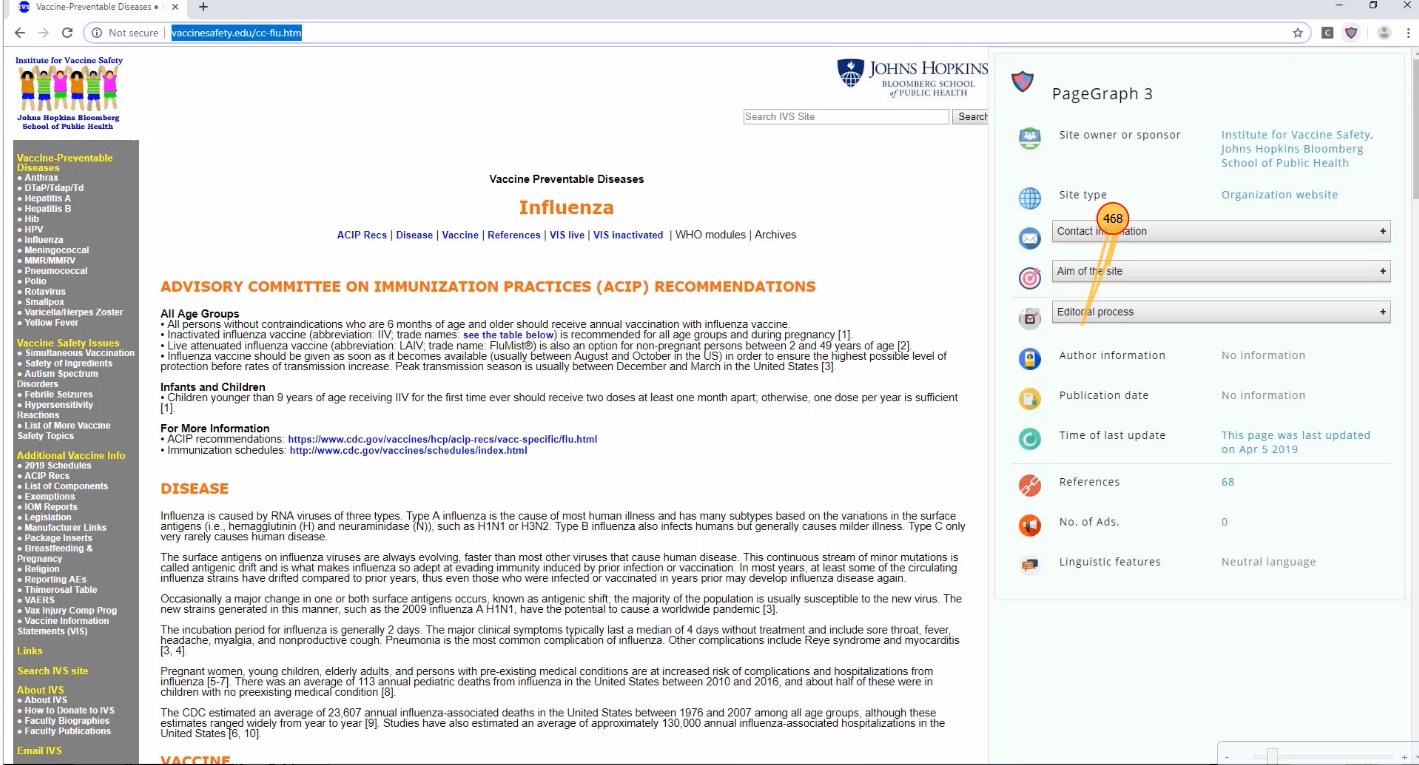
PageGraph extension is shown on the right side of the screen. It includes 11 quality indicators: site owner, site type, contact information, site aim, editorial process, author, publication date, time of update, number of references, number of ads, and linguistic features.
UX EVALUATION & ITERATIVE RESEARCH
Stage 1: Usability Testing with Eye-Tracking
Participants: 16
Methods:
Task-based health information evaluation (9 tasks per participant)
Tobii eye-tracking to capture attention, interaction patterns, and pupil dilation
Retrospective think-aloud interviews using screen recordings
What we learned:
PageGraph significantly reduced mental workload during credibility evaluation
Users interacted with the tool in distinct evaluation modes, depending on website type
Attention patterns (fixations, open frequency) varied across indicators, suggesting that a one-size-fits-all presentation was suboptimal
Eye-tracking data showed lower pupil dilation when users engaged with PageGraph, indicating reduced cognitive effort while evaluating health information.
Stage 2: Design Refinement & Indicator Customization
Based on Stage 1 findings, we refined the design to better reflect contextual needs.
Participants: 60
Method: Controlled lab study measuring indicator usage preferences
Key insights:
Users relied on different indicators for different website types
Author and references mattered more for articles
Ads and sponsorship cues mattered more for commercial sites
Indicators such as site owner, references, ads, and linguistic features should be context-adaptive
This stage directly informed design recommendations for customizable and adaptive credibility cues.

Pupil dilation collected in the eye-tracking experiment for usability tests suggest that when users are interacting with the PageGraph, their mental workload is significantly lower. The extension is effective in lower users’ mental workload while supporting credibility assessment during health-related information search.

The results show that participants use significantly different indicators from PageGraph based on the types of the websites (i.e., commercial, government or dicussion forum). This suggests that the indicators in the PageGraph are important since it can support users evaluations and decisions for diverse health-related webpages.
KEY OUTCOMES & UX IMPACT
PageGraph supports credibility assessment without interrupting search flow
Users experienced lower mental workload while making more informed judgments
Transparent indicators encouraged active evaluation rather than passive trust
Findings highlight the importance of context-aware UX design in health information systems
DESIGN IMPLICATIONS
Credibility tools should emphasize interpretable cues, not opaque scores
UX for health information must adapt to user goals and page context
Behavioral theory provides a strong foundation for responsible, user-centered AI and decision-support tools
